How long before a wound is considered chronic?
A wound is generally considered chronic when it hasn't reduced in size by at least 50% within one month. That's the textbook line. Mine is stricter.
The formal benchmark comes from wound research. A 2003 study in Diabetes Care by Sheehan and colleagues found that diabetic foot ulcers shrinking at least 50% in the first four weeks had a 58% chance of healing by week 12. The ones that missed that mark? Only about 9% healed in the same window. The American Diabetes Association said much the same back in 1999: a wound still open after four weeks is a reason for concern.
I don't wait a month. If a wound shows no real movement in two weeks, I change the order. A different dressing, a new approach, or I start hunting for the thing nobody's addressed yet. Two weeks of a wound standing still is two weeks of warning.
That's the difference between watching a wound and managing one.
Why won't my wound heal?
A wound won't heal when something keeps injuring it faster than the body can repair it. Healing is an active process, not a passive one. Anything that creates constant insult or inflammation stalls it.
The usual culprits I find:
- Infection. A wound fighting bacteria can't move forward.
- Other medical conditions. Diabetes, poor circulation, kidney disease, and more.
- Smoking. It chokes off the blood supply a wound needs.
- Poor nutrition. The body literally cannot rebuild tissue without enough protein.
- Dressings done wrong. Not from carelessness, usually from never being taught how.
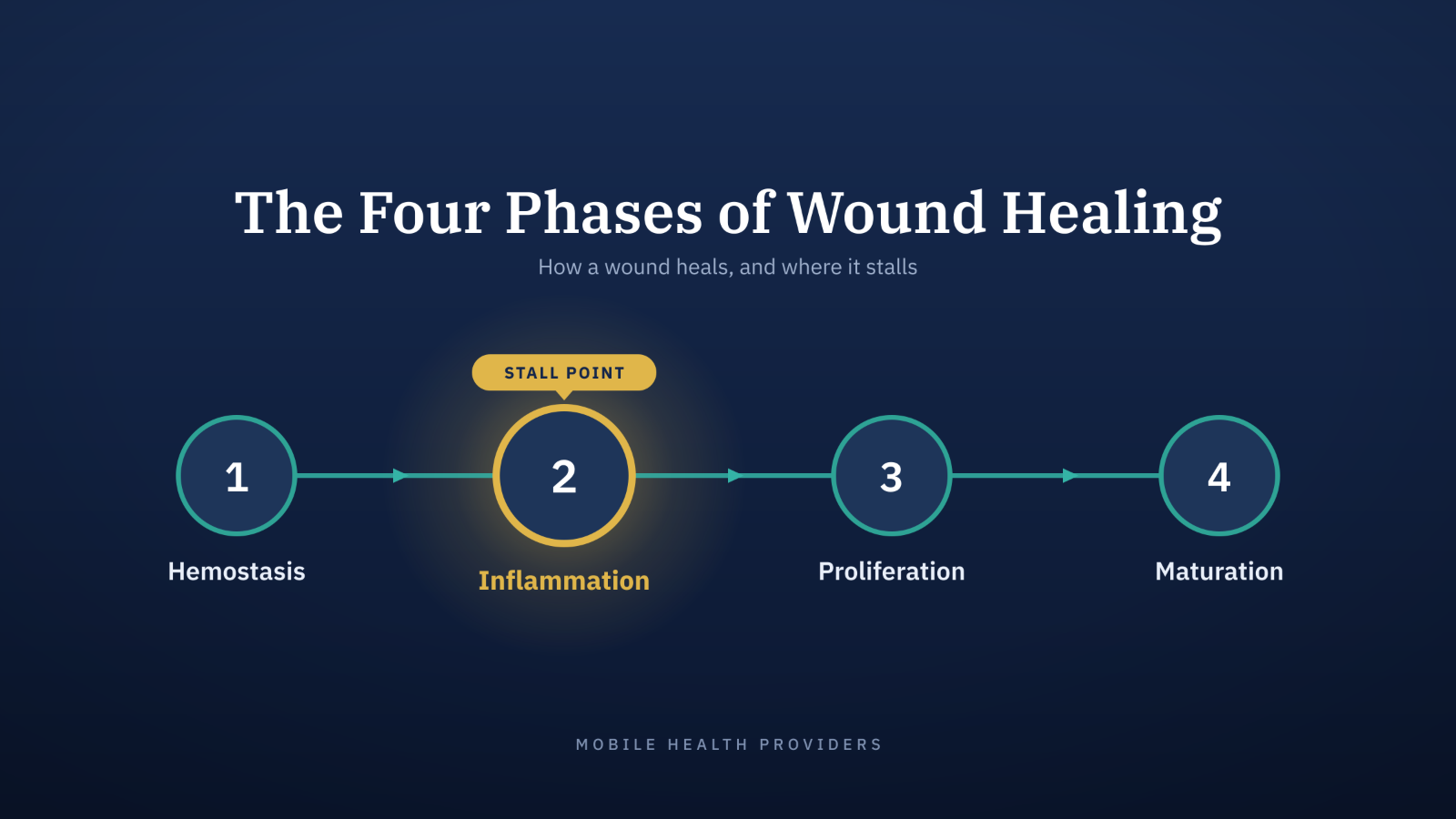
When these go unaddressed, the wound parks itself in the body's cleanup phase and stays there. I break that down in The Four Phases of Wound Healing. If you want the deeper list of reasons, see Why Won't My Wound Heal? Common Causes.
What are the most common types of chronic wounds?
The four chronic wounds I treat most often are pressure injuries, diabetic foot ulcers, venous leg ulcers, and arterial wounds. Each has a different cause, a different look, and a different fix.
| Wound type | Who tends to get it | Where it shows up | What's driving it |
|---|---|---|---|
| Pressure injury (bedsore) | People who are bedbound or chair-bound | Tailbone, hips, heels | Constant pressure cutting off blood flow to the skin |
| Diabetic foot ulcer | People with diabetes, especially with nerve damage | Bottom of the foot, toes | High blood sugar, numb feet, poor circulation |
| Venous leg ulcer | Older adults with leg vein problems | Inner lower leg, near the ankle | Blood and fluid pooling in the legs, swelling, heavy drainage |
| Arterial ulcer | People with poor leg circulation | Toes, outer ankle, top of the foot | Not enough blood reaching the tissue to keep it alive |
Knowing the type matters because the treatment follows the cause. A venous ulcer needs the swelling controlled. An arterial ulcer needs blood flow restored. Treating one like the other gets you nowhere.
What happens if a chronic wound goes untreated?
An untreated chronic wound can lead to serious infection and, in the worst cases, amputation. Those are the two complications I worry about most, short of death itself.
These wounds are more common than most families realize. A 2018 study in Value in Health found that nearly 15% of Medicare beneficiaries, about 8.2 million people, had a wound or related infection in a single year.
The numbers on diabetic foot ulcers are sobering. About 1.6 million Americans develop one each year, and roughly 1 in 5 of those ulcers can end in amputation. The five-year death rate after a diabetic foot ulcer runs around 30%, and climbs past 70% after a major amputation. A 2020 analysis by Armstrong and colleagues found those survival rates rival many cancers.
I don't share that to scare anyone. I share it because almost all of it is preventable with early, consistent care. The wound that gets watched closely is the wound that doesn't become the emergency.
Why do chronic wounds get missed?
Chronic wounds get missed because too many providers treat the hole and forget the patient attached to it. My approach is the opposite. I treat the patient as a whole, not the hole in the patient. For clinicians, the systematic version of that is the TIME framework for wound bed preparation.
Here's what that means in practice. You can put the most advanced dressing in the world on an ulcer, but if the patient's blood sugar is out of control, if they're not eating enough protein, if nobody checked whether blood is even reaching the foot, that wound isn't going anywhere. The dressing was never the problem.
Here's an illustrative example, fictionalized to protect privacy. A homebound man with diabetes has an ulcer on the bottom of his foot. His daughter changes the dressing every day, exactly as she was shown. A clinic has treated the wound for three months. Nobody asked what he eats. Nobody checked his circulation. Once someone steps back and looks at the whole picture, the missing piece turns up fast, and the wound that sat still for months finally starts to close.
That's the gap. Wounds don't heal in isolation, and they shouldn't be treated in isolation either.
How does in-home wound care help?
In-home wound care helps because the people most likely to develop a chronic wound are often the least able to get to a clinic for it. Homebound patients. People who can't drive. Elderly patients for whom a trip to a wound center means an ambulance and a full day lost.
When we bring care to the home, we see the wound on its schedule, not the clinic's. We catch a small change before it becomes a big problem. Early intervention is what changes the outcome, and you can't intervene early on a wound you only see once a month.
We also bring real tools to the bedside, not just dressings. That includes UltraMIST therapeutic ultrasound and MIMOSA Pro imaging, which lets us measure whether a wound is actually getting the blood flow it needs to heal. I explain how that technology works in The Four Phases of Wound Healing.
For patients who qualify, these home visits are covered by Medicare, based on eligibility and medical necessity. If you're caring for someone with a wound that won't close, reach out to Mobile Health Providers and we'll come take a look.
Frequently asked questions
How do I know if my wound is chronic?
If a wound hasn't visibly improved or gotten smaller in two to four weeks, treat that as your signal. A healthy wound shows progress week to week. One that stalls needs a professional set of eyes.
Can a chronic wound heal on its own?
Usually not. By definition, a chronic wound is one that's already failed to heal on its own. Closing it almost always means finding and fixing the underlying cause, whether that's circulation, infection, blood sugar, or nutrition.
How long does a chronic wound take to heal?
It depends entirely on the cause and the patient's overall health, so no honest doctor can promise a date. Many wounds improve within weeks once the right plan is in place. Some take longer. The goal is steady progress, not a guarantee.
Does Medicare cover wound care at home?
Yes, for patients who meet the criteria. Coverage depends on eligibility and medical necessity, not on a blanket rule. We can help you find out whether a patient qualifies.
Is a chronic wound dangerous?
It can be. The main risks are infection and, in advanced cases, amputation. That's exactly why early and consistent care matters so much. A wound managed well rarely reaches that point.
If you or someone you care for has a sore that hasn't changed in two weeks, don't wait for the month to run out. Get eyes on it. Two weeks of no change is the signal, not the month.

Dr. Wyzscx Patacxil, MD, CWSP
Dr. Patacxil is the physician-owner of Mobile Health Providers, a house-call primary care and advanced wound care practice serving patients across San Bernardino, Riverside, Los Angeles, and Orange counties. He treats homebound and mobility-limited Medicare beneficiaries in their homes, skilled nursing facilities, and assisted living communities. His clinical focus includes chronic wound management, chronic care management, and preventive medicine. He writes about wound care, aging, health technology, and what modern house-call medicine actually looks like.
Read more about Dr. Patacxil →About this article
This article is for general education and is not medical advice. Reading it does not create a doctor-patient relationship. Talk with a qualified clinician about your specific situation.
Every wound and every patient is different. Nothing here guarantees a particular result, and outcomes depend on the individual.
Mobile Health Providers is an independent medical practice. We are not affiliated with or endorsed by Medicare or CMS. Coverage for any service depends on a patient's eligibility and medical necessity.
Device and product names are mentioned to describe the care we provide and remain the trademarks of their respective owners.
California license A133325. See our Terms of Use and Privacy Policy.