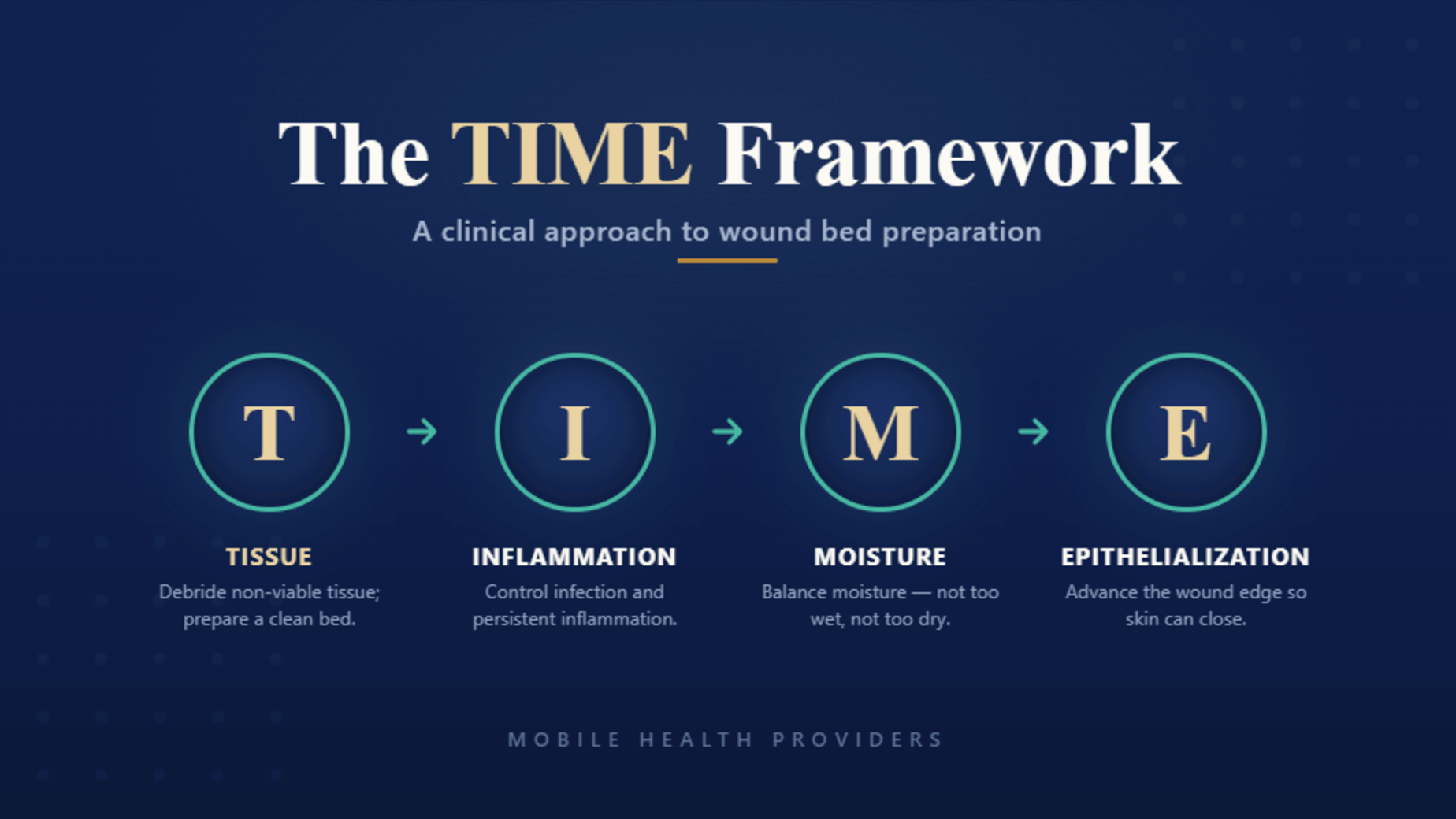
TIME is the framework I use to prepare a wound bed for healing, and it does most of the work in chronic wound management. The letters stand for Tissue, Inflammation, Moisture, and Epithelialization, the wound edge. Get those four under control and you've cleared the local barriers that keep a wound stuck.
I'll put a number on it, with a caveat. If you understand TIME, you're maybe 70 to 80% of the way to managing most chronic wounds. That figure is my clinical gut, not a validated statistic, so don't quote it as one. What sits behind it is real: across more than 50,000 wound care visits over 11 years, I've run this same framework on nearly every patient.
What is the TIME framework in wound care?
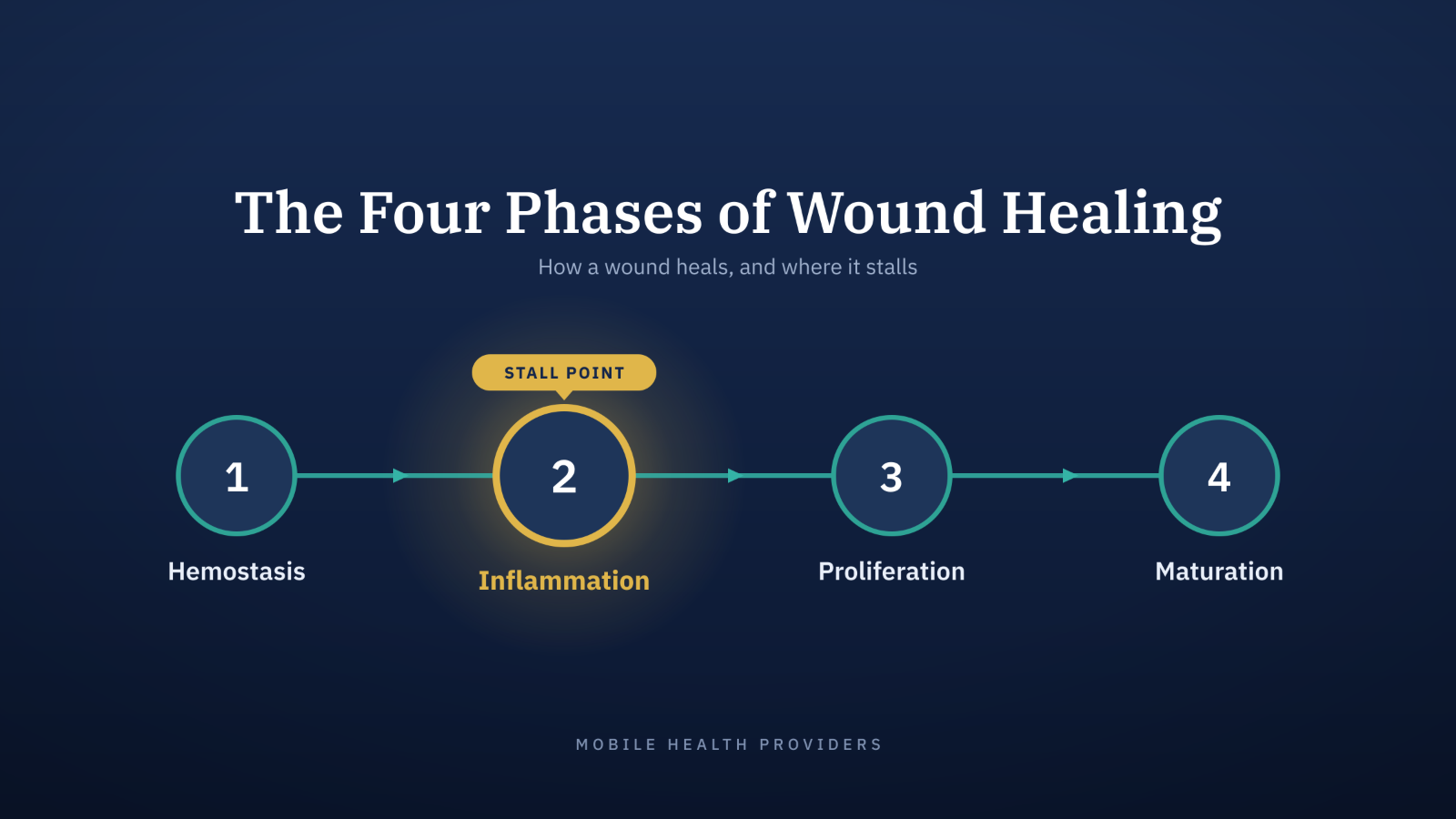
TIME is a systematic approach to wound bed preparation: a working checklist for identifying and removing the local barriers that stop a chronic wound from healing. Schultz and colleagues laid it out in a 2003 consensus paper in Wound Repair and Regeneration, and it has anchored modern wound care since. The premise is simple. A chronic wound is an acute wound that got stuck, and the job is to find where it stalled and unstick it.
The acronym maps to four things you assess at every visit. Tissue, meaning what's actually sitting in the wound bed. Inflammation and infection, the drivers that hold a wound back. Moisture, the balance of the wound environment. And the edge, whether the margin is advancing or stalled.
Here's why I lead with it. Most clinicians who struggle with wounds aren't missing some exotic therapy. They're skipping a step in the basics. Work the letters in order and the wound usually tells you what it needs.
Why does the goal of care come before TIME?
Before you touch the wound, decide what you're trying to accomplish. The framework assumes the goal is closure, and that assumption isn't always right. If the patient is on palliative or hospice care, the goal may be a clean, infection-free wound rather than full healing. That changes everything downstream, from how aggressively you debride to which products make sense.
So I set the goal first. Is this wound headed for closure, or are we maintaining it? Barring contraindications or a reason to hold back, I treat for closure and the rest of TIME applies. When closure isn't realistic, the same letters still guide care, but the target shifts to maintenance and comfort. The TIMERS consensus builds this directly into its pathway, with a maintenance track for palliative wounds.
T is for Tissue: what are you actually looking at?
Start by reading the tissue in the wound bed, because tissue type tells you where the wound sits on the path to healing. There are four main types, and most wounds move along a continuum as they heal. The eventual goal for most wounds is epithelialization, skin closing back over the surface.
Before a deeper wound can epithelialize, it has to fill in with granulation tissue. Granulation is the healing tissue, the beefy red, slightly cobblestoned tissue you want to see. At the other end of the spectrum is necrotic tissue: slough, the soft yellow or tan material, and eschar, the hard black or brown dead tissue. Where a wound falls on that continuum drives the plan.
| Tissue in the bed | What it tells you | Action |
|---|---|---|
| Eschar (black/brown, hard) | Dead tissue, often hiding depth and infection underneath | Debride, after checking perfusion; leave a stable dry heel eschar alone if the limb is ischemic |
| Slough (yellow/tan, soft) | Non-viable tissue and a biofilm reservoir | Debride to a clean bed |
| Granulation (beefy red) | Healthy healing tissue | Protect it, hold the moisture balance, don't over-debride |
| Epithelial (pink, advancing edge) | The wound is closing | Support the edge and protect the new tissue |
When there's significant necrotic tissue, debridement is indicated, and the reason is blunt: that dead tissue is a nidus for infection. It feeds bacteria, shelters biofilm, and physically blocks healthy tissue from filling in. Sharp debridement is one of the mainstays of my practice because it does two jobs at once. It removes necrotic tissue quickly and efficiently, and it disrupts the biofilm sitting on the wound surface. There are several debridement methods, and they deserve their own article. The principle here is that you can't prepare a bed you haven't cleaned.
I is for Inflammation and infection: what keeps a wound inflamed?
Persistent inflammation is one of the single biggest barriers to chronic wound healing. A normal wound passes through an inflammatory phase and moves on. A chronic wound gets parked there, and until you find out why, nothing else you do will hold.
The usual drivers are infection, smoking, and the patient's underlying comorbidities. Infection often means biofilm, not just free-floating bacteria. Biofilm shows up in 78.2% of chronic wounds, per a 2017 meta-analysis in the Journal of Wound Care, which is why I assume it's present in any wound that has failed standard care. Smoking chokes off oxygen and stalls every phase of repair. Diabetes, vascular disease, malnutrition, and immunosuppression each keep the inflammatory signal switched on.
You don't have to personally fix every one of these. You do have to make sure they get addressed. If a patient keeps smoking, or their glucose runs wild, or their arterial supply is inadequate, the wound will sit there no matter how good your dressing is. The clinician's job is to either manage those factors directly or get the patient in front of someone who will. Acknowledging a barrier and doing nothing about it is the same as missing it.
On the wound itself, I go after biofilm two ways. Regular sharp debridement physically removes it, and because biofilm reforms, that debridement has to be repeated rather than done once and forgotten. I also use UltraMIST therapy, a low-frequency ultrasound delivered through a saline mist, which helps break up biofilm and carries the added benefit of increasing circulation to the area. More blood flow means more oxygen and more immune cells reaching the wound.
M is for Moisture: how wet should a wound bed be?
A wound bed heals best when it's moist, not wet and not dry. That's the whole rule, and it rests on some of the oldest hard evidence in the field. In 1962, George Winter showed in Nature that wounds kept moist under a film epithelialized about twice as fast as wounds left to dry and scab over.
Here's the mechanism, with an analogy I use to explain it. Epithelial cells close a wound by migrating inward from the edges toward the center. Picture a person trying to cross a stretch of land. A dry desert is a brutal, slow crossing because there's no water. An open ocean is impossible. The cells need a moist surface, the equivalent of firm, damp ground, to make the trip. Too dry and they stall on the scab. Too wet and the wound macerates and breaks down.
Managing moisture is mostly dressing selection, and the dressing has to follow the wound. If the wound is putting out too much exudate, I use an absorptive dressing such as a foam or alginate to pull the excess off. If it's too dry, I use a dressing that holds or adds moisture, like a hydrogel. The wound changes week to week, so the dressing changes with it. Picking one product and riding it to closure is a common mistake.
E is for Epithelialization: how do you close a prepared wound?
Once you have a clean, granulated wound bed, the last job is getting the edge to advance so skin can close over. A wound that's well prepared but has a stalled, non-advancing edge is the wound that needs more than good basics. This is where adjuncts earn their place.
The modalities I reach for at the edge include negative pressure wound therapy, platelet-derived growth factor (Regranex gel) and collagen, skin grafts, and skin substitutes. The mechanics of each are beyond this article, but they belong in the conversation because they target the same problem: a bed that's ready but won't close on its own.
I'll be honest about how I use the heaviest of these. I don't reach for skin substitutes often. When I do, it's after I've exhausted most of my other options and optimized the patient as well as I can. Most of the time, that optimization plus solid wound bed preparation is all a wound needs. For a wound with genuinely abnormal physiology, a skin substitute becomes worth considering, and I don't commit to one blind. I use MIMOSA near-infrared imaging to check whether there's adequate tissue perfusion at the wound bed. If the perfusion isn't there, a skin substitute is likely to fail, and the imaging tells me that before I've spent the resource. A non-advancing edge after weeks of good care is also my cue to escalate, a point Sheehan and colleagues quantified in 2003 when they showed a wound's trajectory in the first four weeks predicts whether it heals.
What changed when TIME became TIMERS?
TIME picked up two letters. In 2018 a consensus panel reassessed the framework, and the 2019 document by Atkin and colleagues in the Journal of Wound Care introduced TIMERS, adding R and S.
R stands for repair, or regeneration, and it captures the newer regenerative technologies that go beyond standard dressings. S stands for social, and in my experience it's the letter that decides outcomes more often than any product on the shelf. Social factors are the barriers that live outside the wound: complicated family dynamics, no caregiver at home, unstable access to food or transportation. You can apply the most current methods and the fanciest dressings and still watch a wound fail, because the patient goes home to a situation working against them. Recognizing and addressing that is part of the medicine, not an afterthought.
How do I apply TIME on every patient?
I run the same framework on every wound, in the same order. There's no separate playbook for the hard cases. There's the framework, applied carefully and repeated every visit.
- Assess the wound. Look at it, measure it, read the tissue, and set the goal of care.
- Address tissue and moisture. If there's necrotic tissue, debride it. Then get the moisture balance right with the appropriate dressing.
- Evaluate the patient medically. Hunt for sources of chronic inflammation: infection, smoking, glucose control, perfusion, nutrition. Manage them or route them to someone who will.
- Work the edge. Once the bed is ready and the wound has advanced, if it still needs help, bring in the edge modalities under E.
The discipline isn't in knowing exotic techniques. It's in doing the basics at every single visit and not skipping steps because a wound looks quiet that day.
When should you refer a wound to a specialist?
Refer when a wound isn't progressing toward closure on a reasonable timeline, and don't sit on the decision. The TIMERS consensus uses a practical threshold: a wound still present after four weeks of appropriate care should be treated as hard to heal and considered for specialist referral. My own threshold runs tighter. If I'm not seeing progress in about two weeks, I start looking harder for the barrier.
Wound care is a multidisciplinary effort, and I stay involved across the patient's care to keep everyone pointed at the same goal. In my practice that also means programs like chronic care management and principal care management, which give these patients more consistent attention between wound visits. That extra contact earns its keep, because it lets us catch a change early, before a stalled wound turns into a hospital admission or an amputation.
Frequently asked questions
Is TIME still current, or has it been replaced by TIMERS?
Both are current. TIMERS, published by Atkin and colleagues in 2019, doesn't replace TIME so much as extend it, adding repair/regeneration and social factors to the original four parameters. The core TIME assessment is still the foundation of wound bed preparation.
How often should a chronic wound be debrided?
Regularly, not once. Biofilm reforms after it's removed, so debridement is maintenance rather than a one-time event. I debride whenever there's necrotic tissue or a biofilm burden to disrupt, and I pair sharp debridement with UltraMIST to extend the effect.
What does MIMOSA imaging add to wound bed preparation?
It answers a perfusion question before I commit a resource. Near-infrared imaging shows whether there's enough blood flow at the wound bed to expect a good result from a skin substitute or graft. If the perfusion isn't there, I know the advanced therapy is likely to fail before I use it.
When is a wound considered hard to heal?
At four weeks. The TIMERS consensus recommends treating a wound that persists past four weeks of appropriate care as hard to heal and considering referral. I get concerned earlier, at about two weeks without progress.
Can you use the TIME framework on a palliative wound?
Yes, but the goal changes. Instead of closure, you're managing for comfort, odor control, and infection prevention. The same four letters guide care; the target becomes maintenance.
Does biofilm have to be visible to matter?
No. Assume it's there in any wound that has failed standard care. It's found in roughly 78% of chronic wounds and usually can't be seen.
TIME isn't complicated, and that's the point. The wound is a symptom, and the four letters are how you find the cause and clear it. If a wound isn't moving after two to four weeks of honest, every-visit attention to tissue, inflammation, moisture, and the edge, the answer isn't a fancier dressing. It's to work the letters again, look harder at the patient and the life they go home to, and escalate before the wound does.
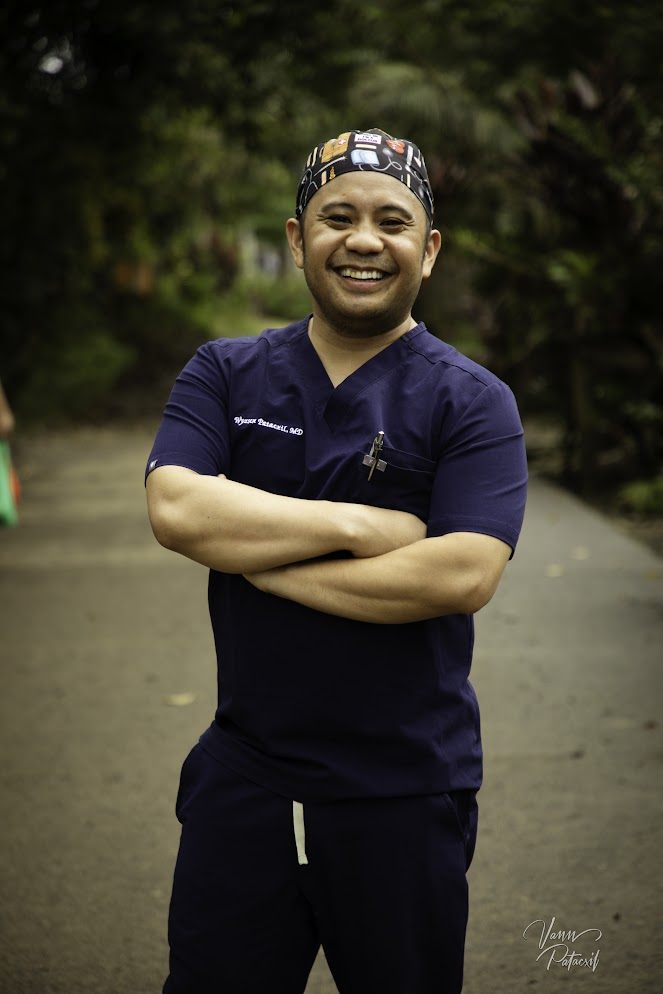
Dr. Wyzscx Patacxil, MD, CWSP
Dr. Patacxil is the physician-owner of Mobile Health Providers, a house-call primary care and advanced wound care practice serving patients across San Bernardino, Riverside, Los Angeles, and Orange counties. He has performed more than 50,000 wound care visits over 11 years, treating homebound and mobility-limited Medicare beneficiaries in their homes, skilled nursing facilities, and assisted living communities. His clinical focus includes chronic wound management, chronic care management, and preventive medicine.
Read more about Dr. Patacxil →About this article
This article is for general education and is not medical advice. It is written for clinicians and does not replace independent clinical judgment for an individual patient.
Every wound and every patient is different. Nothing here guarantees a particular result, and outcomes depend on the individual.
Mobile Health Providers is an independent medical practice. We are not affiliated with or endorsed by Medicare or CMS. Coverage for any service depends on a patient's eligibility and medical necessity.
Device and product names are mentioned to describe the care we provide and remain the trademarks of their respective owners.
California license A133325. See our Terms of Use and Privacy Policy.