What are the four phases of wound healing?
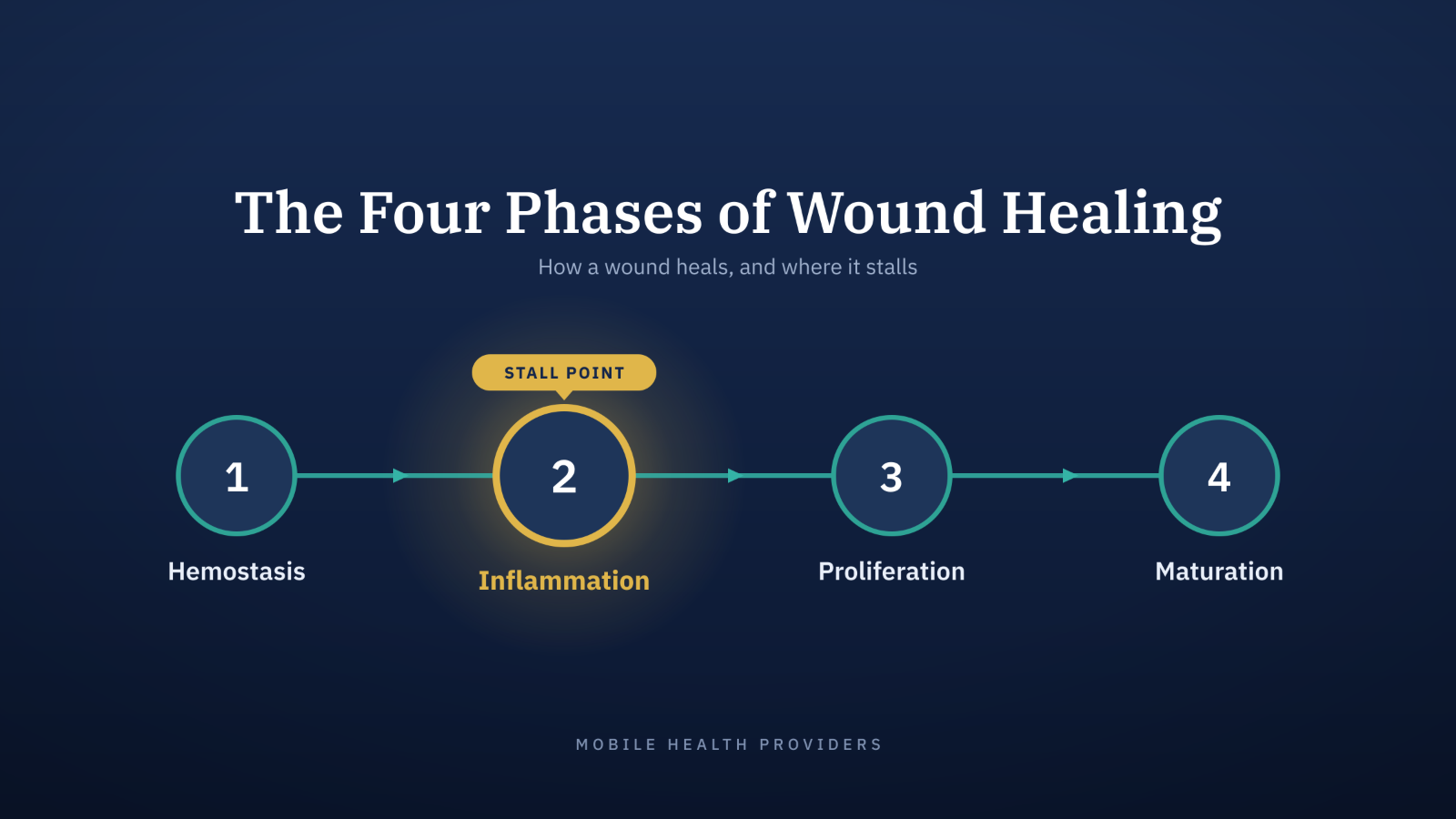
The four phases of wound healing are hemostasis, inflammation, proliferation, and maturation, and they overlap rather than running in clean sequence. Think about a simple cut. The body has a job to do at each stage, and each stage sets up the next.
| Phase | What the body is doing | Rough timing | What stalls it |
|---|---|---|---|
| Hemostasis | Clotting to stop the bleeding | Minutes | Clotting disorders, anticoagulants |
| Inflammation | Clearing dead tissue and bacteria | Days, up to about a week | Infection, biofilm, ongoing pressure or trauma |
| Proliferation | Building new tissue and blood vessels | Days to weeks | Poor circulation, low protein, uncontrolled diabetes |
| Maturation | Remodeling and strengthening the scar | Weeks to a year or more | Final phase; scar tops out near 80% strength |
The timing matters less than the events. According to StatPearls, most wounds close within four to six weeks, and the ones that don't are, by definition, chronic. What follows is what should happen at each step, and what goes wrong when a wound won't move.
What happens during hemostasis?
Hemostasis is the body's first move: stop the bleeding. The instant the skin breaks, platelets rush in, form a plug, and trigger the clotting cascade. Within minutes you have a stable clot sealing the wound.
This phase is fast and usually isn't where chronic wounds fail. It still matters, because that initial clot becomes the scaffold the rest of healing builds on. Patients on anticoagulants or with clotting disorders can have trouble here, but for most chronic wounds, the problem shows up at the next stage.
What happens during the inflammatory phase?
Inflammation is the cleanup phase. Once bleeding stops, the body floods the wound with immune cells to clear out dead tissue, bacteria, and debris. The warmth and swelling around it are the visible signs that the crew showed up for work.
This is where chronic wounds get stuck. If something keeps re-injuring the tissue or feeding the bacteria, the cleanup never finishes, and the wound can't advance to rebuilding. The body stays in alarm mode.
Biofilm is a major reason. A 2017 meta-analysis by Malone and colleagues in the Journal of Wound Care found biofilm present in about 78% of chronic wounds. Biofilm is a protective layer that bacteria build over themselves, and it shrugs off ordinary cleaning and many topical agents. As long as it's there, the wound stays inflamed.
Here's the part too many people miss. You can put the most expensive dressing made on a wound that's stuck in inflammation, and it won't matter. If the infection, the biofilm, the pressure, or the poor circulation driving that inflammation isn't dealt with, the wound stays put. The dressing was never the problem. I cover the bigger picture in What Is a Chronic Wound?.
What happens during the proliferation phase?
Proliferation is the rebuild. With the wound finally clean, the body lays down new tissue, grows fresh blood vessels, and pulls the edges of the wound inward. This is the granulation tissue you want to see: beefy and red.
Rebuilding takes raw material, and the main one is protein. The body literally cannot synthesize collagen without it. The 2019 international pressure injury guideline from EPUAP, NPIAP, and PPPIA recommends 1.25 to 1.5 grams of protein per kilogram of body weight per day for patients with a pressure injury, well above what a healthy adult needs. A frail, undernourished patient who isn't eating enough protein will not build tissue, and the wound will stall right here even after you've cleaned it up.
This is also where blood supply gets tested. New tissue needs oxygen delivered through the blood. A wound bed without enough perfusion can't proliferate, no matter how clean it is.
What happens during the maturation phase?
Maturation is the long reinforcement phase. After the wound closes, the body keeps working underneath for months, reorganizing collagen and strengthening the new tissue. This can run a year or longer.
The new skin never fully matches the original. Per StatPearls, scar tissue tops out at roughly 80% of the tensile strength of uninjured skin and never reaches 100%. That site stays a weak point. For a patient who healed a pressure injury or a diabetic foot ulcer, that means the same spot is vulnerable to breaking down again, which is why offloading, skin care, and follow-up don't stop the day the wound closes.
Which phase do chronic wounds get stuck in?
Chronic wounds almost always get stuck in the inflammatory phase. The body is trying to clean up a wound, but something keeps insulting the tissue, so it never moves on to rebuilding.
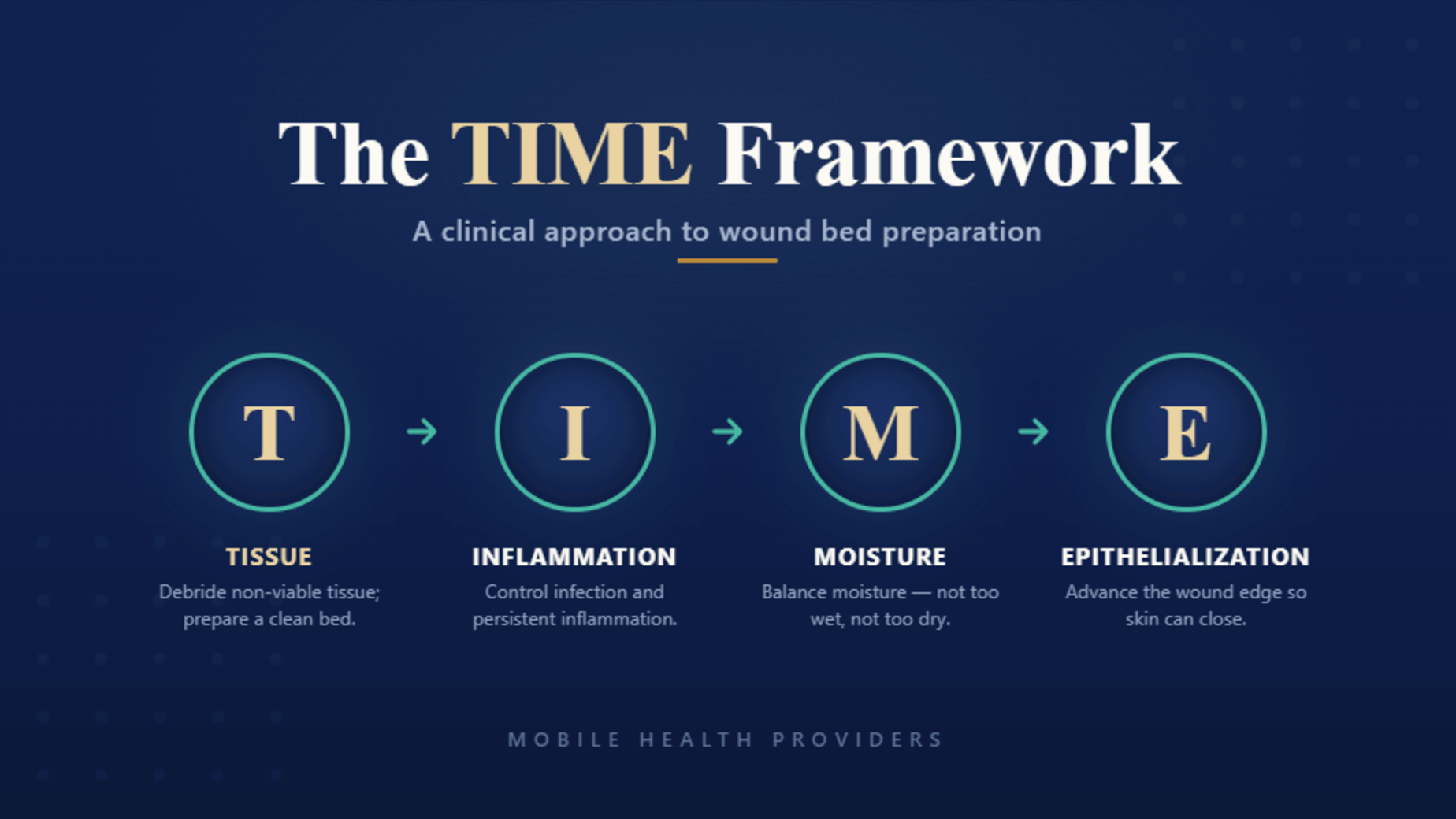
The usual drivers are infection or biofilm, ongoing pressure on the same spot, poor arterial blood flow, uncontrolled blood sugar, and venous congestion that keeps the leg swollen and weeping. Each one keeps the alarm ringing. The clinical work isn't picking a fancier dressing. It's identifying which of these is driving the inflammation and removing it, the systematic work the TIME framework for wound bed preparation exists to organize. Treat the patient, not just the hole.
How does advanced wound care technology map to the phases?
Each tool in advanced wound care targets a specific bottleneck in a specific phase. None of them are magic. They work because they solve the exact problem keeping a wound from advancing.
| Tool | Phase it targets | What it does |
|---|---|---|
| UltraMIST (low-frequency ultrasound) | Inflammation | Disrupts biofilm and drives blood flow to the wound bed |
| MIMOSA Pro (near-infrared imaging) | Proliferation | Measures wound-bed oxygenation to confirm perfusion and track whether treatment is working |
| Skin substitutes | Proliferation | Provide a barrier plus biologic signals that support new tissue growth |
| Compression therapy | Inflammation and exudate control | Pushes venous fluid back toward the heart, cutting the edema and drainage that drown a wound |
UltraMIST goes after the inflammatory stall. Since biofilm sits in most chronic wounds, breaking it up is often what lets the wound finally progress. The same low-frequency ultrasound also stimulates circulation, which feeds the wound bed the nutrients and oxygen it needs.
MIMOSA Pro answers a question dressings can't: does this wound have the blood supply to heal at all? Near-infrared imaging reads the tissue oxygenation in the wound bed. If the oxygen isn't there, no topical product will close the wound, and the right move is a vascular workup, not another dressing. It also tells me whether my interventions are actually improving perfusion or whether I need to change course. That's the difference between guessing and measuring.
Skin substitutes do their work in proliferation. They act as a barrier and bring biologic properties that set up a better environment for the wound to rebuild itself.
Compression is the answer to venous insufficiency ulcers. In a leg with bad venous return, fluid pools, the limb swells, and the wound sits in constant drainage that breaks the tissue down further and makes the ulcer larger. The fluid takes the easiest exit it can find, which is the hole in the leg. Compression reverses that, moving fluid back up toward the heart where it belongs. The evidence is strong: a Cochrane review found that compression heals venous leg ulcers faster and in greater numbers than no compression. One caution: compression can harm a limb with significant arterial disease, so arterial status has to be checked first.
Frequently asked questions
What phase do chronic wounds get stuck in?
The inflammatory phase, in nearly every case. Something keeps insulting the wound, whether infection, biofilm, pressure, or poor circulation, so the cleanup never finishes and the wound can't move on to rebuilding.
How long should each phase of wound healing take?
Hemostasis takes minutes. Inflammation runs a few days, up to about a week. Proliferation spans days to weeks. Maturation can last a year or more. A normal wound closes within four to six weeks; longer than that signals a chronic wound.
Why won't a wound heal even with good local wound care?
Because local wound care doesn't fix systemic problems. If the patient has poor perfusion, low protein, uncontrolled diabetes, or biofilm in the wound, the dressing can be perfect and the wound still won't close. The fix is finding and treating the underlying driver.
How do you know if a wound has enough blood flow to heal?
You measure it. Near-infrared imaging such as MIMOSA Pro reads the oxygenation in the wound bed directly. If perfusion is too low, the wound needs a vascular evaluation before anyone expects it to close.
Is compression safe for every leg ulcer?
No. Compression is the right call for venous ulcers, but it can damage a limb with significant arterial disease by further cutting off blood flow. Arterial status should be assessed before compression goes on the leg.
Dr. Wyzscx Patacxil, MD, CWSP
Dr. Patacxil is the physician-owner of Mobile Health Providers, a house-call primary care and advanced wound care practice serving patients across San Bernardino, Riverside, Los Angeles, and Orange counties. He treats homebound and mobility-limited Medicare beneficiaries in their homes, skilled nursing facilities, and assisted living communities. His clinical focus includes chronic wound management, chronic care management, and preventive medicine. He writes about wound care, aging, health technology, and what modern house-call medicine actually looks like.
Read more about Dr. Patacxil →About this article
This article is for general education and is not medical advice. Reading it does not create a doctor-patient relationship. Talk with a qualified clinician about your specific situation.
Every wound and every patient is different. Nothing here guarantees a particular result, and outcomes depend on the individual.
Mobile Health Providers is an independent medical practice. We are not affiliated with or endorsed by Medicare or CMS. Coverage for any service depends on a patient's eligibility and medical necessity.
Device and product names are mentioned to describe the care we provide and remain the trademarks of their respective owners.
California license A133325. See our Terms of Use and Privacy Policy.