Medicare care management programs are monthly, physician-directed services that keep a patient's care coordinated between visits instead of only at scheduled appointments. They're built to catch problems early and keep patients stable at home.
Medicare funds several versions, including Chronic Care Management (CCM), Advanced Primary Care Management (APCM), Remote Patient Monitoring (RPM), Behavioral Health Integration (BHI), and Principal Care Management (PCM). Depending on which one fits the patient, it adds care coordination between the physician's office and your agency, pharmacy troubleshooting before a refill issue becomes a crisis, and RPM devices that send blood pressure, glucose, or weight readings straight to the physician's office. For a home health agency, that means fewer surprise hospital admissions pulling patients out of the care plan you already built.
What does a care management program actually do?
It's a structured way of staying on top of a patient's health between visits instead of only reacting at the next scheduled appointment. CCM and APCM cover general coordination for patients with multiple chronic conditions. PCM applies when one serious condition is driving most of the risk. RPM adds device-based monitoring on top of any of these. BHI adds behavioral health support for depression, anxiety, or related conditions. What actually happens month to month varies by patient and program, but it typically includes activities like these.
Someone on the care team calls to check in, review symptoms, and update the plan of care. Pharmacy issues get handled before they become a crisis: a rejected refill, a prior authorization stuck in limbo, a new prescription that conflicts with something the patient is already taking. The physician's office and the home health agency stay in sync on what's actually going on with the patient, so nobody is operating on outdated information. Depending on the program, that can also include reviewing RPM data trends or a brief behavioral health check-in.
None of this requires the patient to leave home. That matters for a population where getting to an office visit is often the hardest part of the whole equation.
How does Remote Patient Monitoring work?
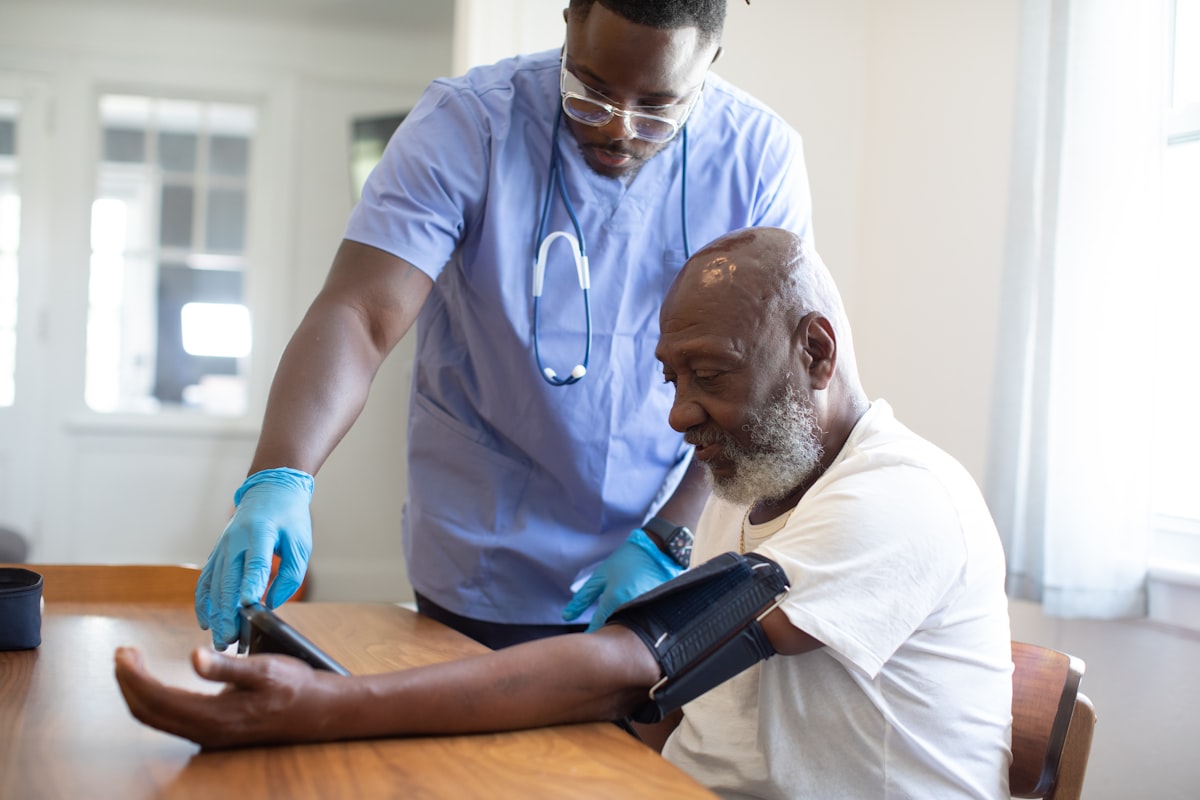
The patient gets a device (a blood pressure cuff, a glucometer, or a scale, depending on what's being tracked) that sends readings automatically to the physician's office. No app to figure out, no manual logging. The device does the work.
Here's why that matters clinically. A patient with heart failure who gains four pounds in two days is telling you something before they feel short of breath. A diabetic whose glucose starts trending upward over a week is telling you something before they end up in the ER with a foot infection that won't heal. RPM catches that signal early enough to adjust a medication or schedule an urgent visit, instead of finding out about it from a hospital discharge summary.
A federally funded Mathematica study commissioned by CMS found that chronic care management reduced hospitalizations and emergency department visits enough to generate real Medicare savings. Published findings summarized in PMC put the net savings at roughly $74 per patient per month when patients stayed enrolled. That's not a marketing number. That's what happens when someone is actually watching the data instead of waiting for the next visit.
Does it cost the patient anything?
Medicare Part B covers care management as a monthly service. Patients typically owe the standard 20% coinsurance, which for most of these codes comes out to a few dollars a month. If a patient has a Medicare Advantage plan or a secondary policy like a Medigap plan, that coinsurance is frequently covered in full, meaning the patient pays nothing out of pocket.
Dual-eligible "Medi-Medi" patients are the clearest case of all. When a patient has both Medicare and Medi-Cal, Medi-Cal generally picks up the Part B coinsurance. And patients in the Qualified Medicare Beneficiary (QMB) program are federally protected from Medicare cost-sharing entirely: providers aren't permitted to bill them for the copay, so there's no out-of-pocket cost at all. A large share of home health patients fall into one of these categories.
This is worth saying plainly to families who assume "another program" means "another bill." For most patients enrolled through us, it doesn't.
What changes for the home health agency?
Nothing operationally. That's the point.
| Without care management | With care management |
|---|---|
| Physician sees the patient at scheduled intervals only | Physician's office is checking in monthly, sometimes more |
| Pharmacy problems surface at the next visit or ER trip | Pharmacy problems get caught and resolved between visits |
| Vital sign trends are invisible until the next appointment | RPM devices flag trends in near real time |
| A destabilizing patient often ends up hospitalized | Early intervention keeps more patients stable at home |
Your nurses keep doing exactly what they do. Your care plans don't change format. What changes is that the physician's office now has more visibility into the patient between your visits, which means fewer patients get pulled out of home health care because of an avoidable hospitalization. A hospitalization doesn't just hurt the patient. It interrupts your care episode, delays your plan of care, and sometimes ends the case entirely if the patient goes to a facility instead of coming home.
Care management is one more layer working toward the same goal your agency already has: keep the patient stable, keep the patient home, keep the care continuous.
The bottom line
This is a rare setup where every party benefits from the same outcome.
- The patient gets more oversight and, in most cases, no additional cost.
- Medicare saves money through fewer avoidable hospitalizations.
- The home health agency keeps its care episodes intact instead of losing patients to hospital admissions.
- The physician gets earlier signal on a patient's condition and better outcomes to show for it.
Nobody has to change what they're already doing well. The program exists to protect that work, not compete with it.
Frequently asked questions
Does care management replace my home health nurse visits?
No. It runs alongside your visits and adds monitoring and coordination in between them.
Which patients qualify?
Generally, Medicare patients with two or more chronic conditions, or any Medicare patient depending on the specific program tier. Most home health patients qualify.
Do I need to submit a separate referral for this?
No. If the patient is already under our care, we can enroll them directly. A simple heads-up from your team is enough.
Can a patient be in home health and a care management program at the same time?
Yes. There's no conflict between the two. They serve different functions and Medicare permits both concurrently.
Does the RPM device require the patient to do anything complicated?
No. The patient takes the reading (blood pressure, glucose, or weight) and the device transmits it automatically. No syncing, no app.
What if the patient doesn't want a device in their home?
Care management still works without RPM. The monthly check-ins, pharmacy coordination, and care planning happen regardless.

Dr. Wyzscx Patacxil, MD, CWSP
Dr. Patacxil is the physician-owner of Mobile Health Providers, a house-call primary care and advanced wound care practice serving patients across San Bernardino, Riverside, Los Angeles, and Orange counties. He treats homebound and mobility-limited Medicare beneficiaries in their homes, skilled nursing facilities, and assisted living communities. His clinical focus includes chronic wound management, chronic care management, and preventive medicine. He writes about wound care, aging, health technology, and what modern house-call medicine actually looks like.
Read more about Dr. Patacxil →About this article
This article is for general education and professional information. It is not legal, billing, or compliance advice for your specific situation. Medicare coverage and coding rules change; verify eligibility and coverage against current CMS guidance before enrolling a patient.
Patient cost-sharing depends on individual eligibility and secondary coverage. We verify each patient's coverage before enrollment.
Mobile Health Providers is an independent medical practice. We are not affiliated with or endorsed by Medicare or CMS.
California license A133325. See our Terms of Use and Privacy Policy.